Tuesday, February 19, 2013

Australian Marriage Update

I last posted about marriage equality in Australia in August 2011, and things were looking very promising here at that time.  It has been a year and a half since then, and a lot has happened around the world.  Denmark became the eleventh country to legalize marriage for same-sex couples.  In November 2012, voters in the US states of Washington, Maine, and Maryland changed the tide when they voted for marriage equality for the first time in US history, and voters in Minnesota at the same time rejected an amendment that would have enshrined marriage discrimination into their state constitution.  The Mexican state of Quintana Roo legalized nuptials for all, as did courts in four of Brazil’s 26 states and their national capital:  Alagoas, Bahia, Brasilia, Piaui, and Sao Paulo.  There were further court victories in the Mexican state of Oaxaca and activists there seem to have a state-by-state court-based solution to remedy their inequality.  More recently, marriage equality has passed crucial votes in Uruguay, England, France, and just over the water in New Zealand.  All four of those countries are expected to have full marriage equality in the coming months.  On top of that, there are serious movements in Ireland, Scotland, Luxembourg, and even Colombia to bring marriage equality to all.  Hell, even Thailand is about to vote on civil unions and the government of Vietnam is currently looking at that as well.  Holy crap!

Back in the US, the legislatures of Illinois and Rhode Island each had one chamber pass marriage equality, and both states appear poised to pass marriage legislatively in the very near future as Democrats control the other chamber in both states.  A measure is being introduced in Minnesota this week, Delaware shouldn’t be too far behind, civil rights campaigners are busy shoring up support to override the fat-ass governor’s veto in New Jersey, and Colorado should have civil unions by the end of this month.  Hell, same-sex marriage was even brought up in New Mexico, Texas, and Wyoming!  Not that is has any chance in any of those states right now, but it’s at least being talked about there.  Who would have thunk?  Five other states are looking to overturn the marriage discrimination amendments in their constitutions in 2014, and both the so-called Defense of Marriage Act (DOMA) and Proposition 8 cases are scheduled to be argued in front of the Supreme Court in March, with decisions handed down by June.  It could be horrifying, or the best thing ever.  Let’s hopes the justices do what’s right and strike down both discriminatory laws as all lower courts have done before them.

So, what about Australia?  The governing Labor Party voted to officially include marriage equality in their party platform in December 2011.  Despite that, Prime Minister Julia Gillard proposed allowing conscience vote on the issue – so members of the party can vote against party platform if they want to.  With that, it pretty much dashed any hope of bringing equality to hundreds of thousands of Australians who need it.  The leader of the Liberal Party (Australia’s right-wing party) refuses to allow a conscience vote on the issue despite quite a few high profile members of his party supporting it.  Nevertheless, a marriage equality bill was brought up in the House of Representatives where it was defeated swiftly – 42 to 98.  That’s a ridiculous defeat for a country where polling suggests 70% of the population is in favour of the change and for a country where Macklemore’s song “Same Love” about gay rights and marriage equality – which only scratched the charts in the US, topping out at # 89 – went all the way to # 1 here down under.  The public want this change, but politicians are playing dirty games and catering to a few critical swing voters.

Next up:  maybe a state based attempt?  Marriage has been regulated federally in Australia, but legal scholars don’t seem to agree on what would happen should a state pass a marriage equality law.  Tasmania tried to legislate for marriage equality a few months ago.  It passed one house of their Parliament, but missed out by two votes in the other.  It seems some of their Members of Parliament didn’t want to thrust little Tasmania into a battle over marriage with the federal government.  My state, New South Wales, is the largest state with the most resources to defend any marriage equality law from the federal government.  The state Parliament currently has an enquiry out to the public, and it looks like it may come up for a vote in a few months.  Victoria and South Australia have also had rumblings and it will be interesting to see how it all plays out.  We know it is inevitable, but just how long will Australia wait and just how far behind other parts of the world will they fall before the government grows some balls and takes some action?

Now, we know that the laws here don’t provide marriage equality for all Australians, but that doesn’t mean that loving gay and lesbian couples can’t get married.  When civil laws of a country fail, sometimes there’s a religious law that will back you up.  It is surprising that so many people hide their bigotry behind their religion, but as I’ve experienced it, religion is one place where you can and should be accepted.  Enter two of my best mates:  Elcid and David.


Late last month, Elcid and David tied the knot in a religious ceremony and a lavish reception to rival all other weddings.  As many or most Jews are very liberal, the local synagogue had no issue performing a religious wedding for the boys (as long as both were Jewish, so Elcid spent the last who knows how long going through the conversion process.)  The synagogue called both grooms up to the Torah on the Shabbat before the wedding – a religious ceremony called the aufruf.  On the day of the wedding, the two grooms took their place underneath the chuppah (Jewish wedding canopy) and Rabbi Ninio united them together as a married couple in the eyes of God.


They signed the ketubah (Jewish marriage contract) and then they both stomped on glass – a symbolic Jewish wedding custom) before moving into the reception hall.  Of course, we had to hoist the boys up on chairs and dance the Horah!


Then there were drinks, food, more drinks, more food, and a crazy photo booth where Team America shined! (Elcid is also originally from the old country)


Then I had to give the big speech that I had been panicking over for weeks – and fortunately it went extremely well (despite me incorporating the word “penis” into the speech… four times…)  And then there was cake.


Delicious cake.  Made by a friend of theirs.  And it had the world’s cutest wedding cake toppers WHICH MATCHED THE BOYS’ OUTFITS.


See?!?!?  Now, I don’t know if they had the cake topper made that way, or if they picked out their outfits based on the topper that they found, but it was amazeballs.  EVEN THE KIPPAHS MATCHED!  Let me repeat:  even the fucking kippahs matched!  HOLY AMAZEBALLS!

From start to finish, the wedding was absolutely perfect – every detail.  Except for the length.  I wouldn’t have been opposed to another hour of dancing!  At the end, the boys exited stage left and the rest of us went home full, tired, and slightly tipsy.  Or a bit more than slightly tipsy.  Perfect night!


So my question is – especially posed to Prime Minister Gillard – if our synagogue recognizes this marriage between two loving adults as equal to all other marriages performed in the eyes of God, why can’t Australia recognize that as well?  Why can’t Australia – and all of the other countries out there – respect our religion and let us decide for ourselves what is right and what is wrong?  Marriage equality isn’t just a civil rights issue.  It’s also a religious freedom issue.  Now if you’ll excuse me, I need to go make my submission to the New South Wales marriage equality inquiry.


Monday, February 11, 2013

Dirty Thirty Down Under

All of those years of making fun of people over thirty finally came back to bite me in the ass.  At the beginning of this month, my odometer hit 30 years old.  Eeeek!

One of the great things about being in Australia is that I now have a summer birthday – no more Seattle rain to gray out my big day.  Furthermore, I sort of have two birthdays.  I was born on February 1st, but if you go down to the minute, the 18-hour time change between Sydney and my birth state of New Mexico meant that my odometer didn’t actually tick over until early afternoon on February 2nd.  So I did what any reasonable person would do:  I celebrated both days.

Friday night – my American birthday – was spent with my close circle of friends.  One by one they braved the pouring rain (so much for a sunny summer birthday) and showed up at my apartment to indulge in two bottles of 10-year old Semillon that I had been saving for a special occasion.


They came bearing inappropriate birthday cards and fantastic gifts of fancy coffee mugs, a credit on my car share membership, a bottle of wine from my favourite winery, lots of American delicacies, and more!


Another bottle or two later, and our little group was off to Food Society, a delicious Modern Eastern European restaurant situated less than two blocks from my apartment.


We had a feast of cheeses, meats, amazingly delicious cauliflower (who knew?), substantial main dishes, and of course, desserts!


Being Eastern European, the restaurant also has an extensive selection of vodkas, and once we spotted the Peanut Butter & Jelly Vodka, we knew we had to do a shot.  Or two.


Dear lord it was amazing.  I seriously need to find this PB&J vodka in stores.

Then on Saturday – my Australian birthday – I rented out the big back room of a local trendy pizza joint not too far down the road.


Mad Pizza played host to me and 50 of my closest friends in Australia.  It’s amazing to me that I’ve been here just a smidge over three years and had 50 people at a party.  What’s even more amazing is that I had invited just over 60 people.  And even more amazing is that those 60 people were the short list – weeded down from a larger group of people that I’ve become friendly with in this country.


The group included the gays, the Jews, the gay Jews, some co-workers, a handful of Americans, and a cluster of others that I’ve met randomly along the way and have grown quite fond of since arriving down under.  Salads and pizzas and drinks and tiramisu and a super cute waiter to look at and a sneaky tequila shot later, the night was over and I went home to slumber in my old age.  I said no gifts, but a few cheeky friends refused to show up empty handed.  The majority of the gifts involved chocolate in some form or another, and I’m slightly embarrassed to admit that the stash didn’t last too long.


So, what’s on the agenda for 30?  Well, now that I’m getting old, I think bread with more fiber is in order, as is shampoo for thinning hair.  But on a more positive note, travel will be the big focus this trip around the sun.  I plan to cross at least 7 items off my list of 103 things.  As birthday gifts to myself, I booked flights up to Cairns – home of the Great Barrier Reef – for a week with my sister when she comes out to visit, and a bigger, longer, and more expensive flight to Helsinki toward the end of the year.  I’ve always had a fascination with Scandinavia, and I couldn’t be more stoked to be spending a few days in Finland.  After a stop in Estonia, I’ll be heading to Russia to meet up with my high school friend Lenora.  We’ll ride the Trans-Siberian Railway across from St Petersburg to Moscow and on to Irkutsk before turning south for a few days in Mongolia.  And, just for good measure, I think I’ll book in an extra-long layover in Seoul for the way back.  Long weekend trips to Canberra, Brisbane, and maybe even Singapore are in the works, and I’ve had my eye on New Zealand for some time now too.

Aside from my extensive travel, thirty will hopefully be filled with more friends, more fun, and probably more pizza.  A lottery win wouldn't hurt either (all this travel is breaking the bank!)  And maybe a little bit of dirty too.

But only because it rhymes.  I like rhymes.


Thursday, January 31, 2013

Sweaty Work Shirts

Dear Australians,

On the right guy, you know that business attire can be very sexy.  Slacks that gently grip the butt.  Slim fit button down shirt.  Even a tie and tailored jacket when needed.  But do you know what is not sexy?  When that button down shirt is 70% covered with sweat stains.

Why, Australians, why do you not wear undershirts?  Not one of you do.  And in summertime here, it never ceases to amaze me just how many men walk around Sydney – both on the street and even in my office – with sweat stains on their shirts.  In the elevator in the morning, I follow men in who have giant sweat stains from their collar all the way down their back to where their shirt meets their pants.  It is not sexy.

Sweat stains on an exercise shirt can be sexy.  Soccer players – running around the field – getting all sweaty in their jerseys or polos or whatever they are wearing.  Yummy.  Runners – in their tank tops or singlets or whatever you want to call it – their arms glistening with sweat as the subtle stains on their torso coverings slowly grow as they run meter by meter through the botanical gardens.  You look hot, Mr. Runner, let me blow on you to cool you down a little.  And you, man in the business shirt, that expensive shirt with the giant sweat patch on the back, oh baby… oh wait, no.  That’s not sexy.  Not at all.

American men know that a sweaty work shirt is a turn-off.  Canadian men know that a sweaty work shirt is a mood killer.  European men know that a sweaty work shirt is a boner shrinker.  Why then, why have you Aussie men not received the memo about sweaty work shirts?  When I first moved here I would wear an undershirt to work every day so that nobody would see any potential sweat stains that came through, and because I wouldn’t need to wash and iron my work shirts as often.  I could get two uses out of them, especially in winter, and sometimes even in summer.  But then I noticed that not another soul in the office was wearing an undershirt.  And I stopped wearing them so I could fit in like an asshole.  And now I have to plan my attire around the weather report.  Tuesday is going to be hot – can’t wear gray or green!  Must stick with that striped shirt or solid black.

But, still, sometimes I will put on an undershirt, especially on those really hot days.  And when I do, without fail, several people will ask me, “Are you wearing a t-shirt under your shirt?” or “Aren’t you hot with that extra shirt on?” And my answer, is “Yes, I am wearing an undershirt, and yes I am hot with it on, but you know what, I’d be hot without it on.  In fact, I’d be scorching even if I was completely naked right now, because you know what?  IT’S 115 FUCKING DEGREES IN THIS CITY AND ONE LITTLE LAYER OF COTTON ISN’T GOING TO MAKE A DAMN BIT OF DIFFERENCE WHEN IT COMES TO MY FUCKING BODY TEMPERATURE.”

Here, let me take my undershirt off.  It’s still 115 degrees outside, but now that I’ve removed my white Hanes t-shirt, my body temperature has cooled dramatically and I think I might need a jacket now!  Amazing!

Or not.  Ok, so I’ll agree that the one little layer of cotton may increase my body temperature by a degree or two, maybe.  But is there really a difference between 113 and 115 degrees?  I’m going to be uncomfortable no matter what I’m wearing, but at least with an undershirt, a lot of the sweat that flows like Niagara from my body will be soaked up by my trusted cotton friend and will not make its way to visibility on the outside world.  Yay!

So, Aussies, I highly recommend you embrace the undershirt, or at least stop asking me all those questions when I wear one.  And if you choose not to embrace the undershirt, well, you can sit there with the giant sweat stain which has engulfed your entire back and most of your front – so badly that your wet shirt is now clinging to your skin.  And your only hope will be for that stain to quickly continue growing down the length of your sleeves thus rendering your shirt 100% wet for a full covering – so that it no longer looks like a sweat stain but instead just a darker shirt.

Just don’t give anyone a hug.  Eeeek.

Sincerely,
Phill


Monday, January 28, 2013

Record Heat, Bushfires, Rain, Floods

While all you North Americans are having white Christmas, and skiing, and ice skating, and drinking hot chocolate by the fireplace… all of us here in Australia are sweating our balls off.

Did I mention it’s fucking hot here?  All of y’all are in front of the fireplace and we here might as well be in it.

Last summer in Sydney was a wash – literally.  It wasn’t all that hot, but it was one of the wettest summers on record.  And the humidity.  Don’t even get me started on the humidity.  It wasn’t even that hot and I was still dripping with sweat constantly.  Thank goodness I could pass it off as rain.  “No, no, I swear it’s water!  I had an umbrella malfunction!”  But leading up to this summer, the meteorologists kept saying it’s going to be a hot, dry one.  Not that they’re ever right about these things, but I was hoping they would be for once.

And they were somewhat right.  January 8th rolled around and, well, this happened:


Yes, that says 108 degrees Fahrenheit.  And yes, I’m using Fahrenheit because you can’t teach an old dog new tricks and 100 degrees sounds a lot more impressive than 40.  Seriously.  Tuesday, January 8th was the hottest day ever in Australia based on the average of high temperature readings taken at several hundred spots around the country.  While it wasn’t the hottest day ever in Sydney, I believe it was in the top 5 since records began being kept a century ago.  Furthermore, the heat persisted into the night.  The temperature was still above 100 degrees Fahrenheit at 10pm.  10pm!  Those looking for respite from the oppressive heat were still swimming at Bondi Beach after midnight.  Why don’t more houses have air conditioning in this city?  With temperatures like that, only a bunch of crazy people would live without a frosty blast of air constantly streaming into their apartments.

And I suppose I’m crazy because I’m one of them now.

The dry heat sparked a rash of bushfires across the country, most notably in New South Wales, Victoria, and Tasmania.  Bushfires are the major natural disaster in Australia.  The fires are necessary in some ways – they are a vital part of Australia’s ecology as they help certain native plant species to germinate and they encourage new growth of grassland plants.  Controlled burns – started by professionals in the right conditions for containment – are common in Australia.  But when natural fires breakout, they can easily get out of control.  High winds on hot days can spread fires rapidly, killing humans and wildlife and destroying homes and other buildings across hundreds of square miles.  Fires of any sort are banned statewide on these days, and anyone who starts a fire purposefully is prosecuted and shunned by the media.  Major highways are closed, whole regions evacuated, and news coverage is pretty much non-stop, giving regular updates on evacuations, homes destroyed, and lives lost.  In Tasmania, major fires at the top of the Tasman Peninsula stranded thousands of residents and tourists until ferries could be sent from Hobart to rescue them.  The Hume Highway, the major highway between Sydney and Melbourne was closed down in parts for fear of fires crossing the road, or because the smoke was just too thick and visibility was impaired or eliminated altogether.

And just when the heat had subsided and the bushfires were getting under control, Mother Nature dropped a surprise on us – and on meteorologists.  They didn’t forecast it, and we weren’t expecting it, but on last Friday, January 18th, Sydneysiders were treated to a lovely day of this:


The hottest day ever on record in Sydney.  EVER.  But at least it only felt like 111 degrees Fahrenheit instead of the full 115 degrees, right?

Fuck that.

It broke a 74 year old record set back in January 1939.  Unlike the week before when we knew it was coming and could prepare, this took everyone by surprise.  Many people were hospitalized due to the unexpected temperatures, and buses and trains were overheating causing some major transport headaches.  Work let us out a bit early due to the heavy traffic conditions.  And although I live only a 10 minute walk from the office, I was completely drenched in sweat by the time I arrived home.

And then, that evening, I went for a 6 kilometre run.  On the hottest day ever.  What a feat!

Actually, a cold front came through just after 5pm and dropped the temperature dramatically – by 30 degrees Fahrenheit or something ridiculous like that.  So I wasn’t so crazy to do it.  But that just exemplifies how crazy the weather has been here lately.

Oppressive heat, record high temperatures, and out-of-control raging fires one day, and then cool and rainy the next.  It was hot as hell for Australia Day celebrations on Saturday – my shirt was so sweaty that it had nearly completely changed colour.  How embarrassing.  And today, on Monday, just two days later, it’s pissing down rain across the entire eastern half of the country and they’ve pre-empted The Ellen DeGeneres Show to give full coverage to the massive floods currently engulfing Queensland yet again.

Why can’t Mother Nature just make up her mind?  Or is she just fucking with us for a cheap thrill?

What a bitch.


Thursday, January 24, 2013

Royal Flying Doctor Service

When out in the outback in November, I looked down at my phone and realized that I didn’t have reception across some fairly substantial chunks of land.  If something happened to us, we’d be fucked.  But for those who live out in the middle of nowhere, there are satellite phones to cure that problem.  But what about health care?  In a medical emergency, what good is a satellite phone when the nearest hospital is still hundreds or even thousands of kilometres away?

As I’ve mentioned before, Australia is vast country yet sparsely populated for its size.  63% of the population lives in the five big cities – Sydney, Melbourne, Brisbane, Perth, and Adelaide.  Add in the next five largest cities – Gold Coast, Newcastle, Canberra, Wollongong, and Sunshine Coast – and that figure shoots up to 73%.  For comparison, only 17% of Americans live in the five largest cities in the US – New York, Los Angeles, Chicago, Dallas/Fort Worth, and Houston – and that increases only to 26% if you include the next five largest cities – Philadelphia, Washington, Miami/Fort Lauderdale, Atlanta, and Boston.  Australia is heavily concentrated in big cities.  85% of Australia’s population lives within 50 kilometres of the coast, and that figure increases to 90% if you increase the distance to 120 kilometres.

Basically, the point I’m trying to make here is that there is nothing in the middle of Australia.  Most people live in the big cities on the coast and the middle is pretty empty.  Drive a short while away from the coast and, well, you’ve lost mobile phone reception and all contact with other humans until you arrive somewhere near the other coast on the other side of the country.  Yet, people still live in the middle – not too many for sure – but some.  While they may be few and far between, small towns dot the main routes across the middle.  They may be mining settlements, stopovers for long haul drivers, or remnants from more successful years long ago, but they are there.  They may be just one or two families, but they are there nonetheless.  There are also plenty of indigenous communities far away from the population centres, and farmers raising cattle and other livestock at remote stations well off the paved roads.

It’s hard to imagine how essential services can be provided to such remote locations, especially healthcare.  This problem was on the mind of Reverend John Flynn over 100 years ago.  Flynn was a recently ordained Presbyterian minister in charge of an inland mission, but he soon realized that those living in the vast outback needed medical care in addition to the word of god.  He was soon responsible for the establishment of 15 bush hospitals in remote locations, but even then, proper medical facilities remained inaccessible to much of the outback.  Taken from a synopsis of a 1941 movie called The Flying Doctor on the Australian Screen website:

“Flynn told many stories to illustrate the need for medical care in remote locations. One such story is that of Jimmy Darcy, a stockman who was hurt in a fall at Ruby Plains Station, 75 kilometres south of Halls Creek in Western Australia in 1917. Darcy was transported to Halls Creek, 12 hours away by buggy, but on arrival there was no doctor there. Friends then attempted to contact a doctor by telegraph. After relaying the injured man’s symptoms, the doctor gave instructions to operate on Darcy. It was a ten day journey for the doctor by car, horse-drawn sulky and foot to reach Darcy, by which time – due to an abscessed appendix – he was already dead. This dramatic story emphasised the need for emergency medical care in the outback and enabled Flynn to advance his cause for an aerial medical service. The Aerial Medical Service (the precursor to the Royal Flying Doctor Service) was established in 1928.

Can you imagine?  The operation that the amateurs performed (with a pen knife… on a post office counter…) actually was successful, but Darcy died a day before the doctor arrived from a completely different complication.  What rotten luck.

 So, Flynn stepped it up a few years later and decided to use new technology – radios and airplanes – to create the world’s first aeromedical service:  the Royal Flying Doctor Service.

I had heard of the RFDS when visiting Alice Springs in 2011, but didn’t know too much about it so didn’t bother checking out their visitor centre.  After some additional research upon my return, I decided that I had missed out and it was definitely something I wanted to learn more about the next time I was in a large outback town.  Kalgoorlie gave me that opportunity.

The RFDS is the largest and most comprehensive aeromedical organization in the world.  It operates as a not-for-profit and gets funding from the government.  The RFDS is vital for those living in or traveling to remote areas of Australia.  The RFDS has 21 bases and 39 clinics across the country.  With 1,150 employees and 61 small aircraft, the organization transfers an average of 112 patients per day from the remote outback to large towns and cities where they can receive proper medical care when they need it.  RFDS planes fly an average of nearly 73,000 kilometres per day, or roughly 22 trips across the continent from Sydney to Perth.

RFDS doctors and nurses also provide health education to those living in remote areas, and staff various call centres 24/7 for those medical questions or emergencies that don’t need patient transport to a hospital.  For easy treatments, the RFDS began distributing standardized medical kits to remote areas in 1942.  Call up the RFDS and describe your symptoms, and the doctor on the other end of the line will tell you to take a pill from the compartment labelled “4” (or whatever other compartment contains the cure to your ailment).


There are more than 2,000 medical kits across isolated Australia.


All up, the RFDS interacts with 750 patients per day and responsible for over 273,000 patients per year.  Not bad.

The RFDS gets funding from the government, enough to cover their main operating costs and their aircraft.  Other new equipment, including aircraft fit-outs, is out of pocket for the RFDS and they rely on contributions from the community, sponsorships from large companies, and donations from visitors to their visitor centres.  This is where we came in.

At their visitor centre, we got to see the old radios they used back in the early years of the RFDS.  You had to pedal while you talked to operate the phone.  It wasn’t easy.


We also learned some more interesting tidbits, like the presence of Revered John Flynn on the $20 note, alongside an original RFDS airplane, the radio pedals, and other medical instruments.


Most importantly, we got to see a Royal Flying Doctor Service airplane and even have a look inside!


Ok, not that one.


That’s better.


So, when out in the outback and you stumble upon a Royal Flying Doctor Service visitor centre, go in and learn something more than I just taught you.


And write their phone number down because you never know when you might need them.


And give generously too.  They do good work.


Tuesday, January 15, 2013

Rabbit Proof Fence

In 1859, a man in Victoria imported 24 wild rabbits from England so that he could have something to hunt on his property.  As rabbits breed, well, like rabbits, the little ones got busy bumping and grinding and reproduced quickly.  Conditions in Australia were just right for rabbit procreation:  warm weather yielding a year-round breeding season, lots of low grasses and shrubbery for them to eat, and no natural predators on the continent… anywhere.  As the rabbits increased in numbers, they moved beyond the original property into neighbouring lands, then across Victoria and the whole of Australia.

The rabbits have had a devastating effect on Australia and they are widely considered to be the biggest contributing factor to species loss in this country.  Rabbits compete with native species for food and burrows.  The bilby is the most notable example.  The Lesser Bilby is believed to be already extinct due to competition from rabbits, and the Greater Bilby is vulnerable.  This is one of the main drivers of switching the Easter Bunny to the Easter Bilby in Australia.  Rabbits also cause soil erosion as they devour plants and this can have harmful effects for agriculture, livestock, and the economy.

Over the years, the government has implemented a wide variety of measures to either control or eradicate the rabbits, including shooting, trapping, poisoning, fumigating, or ripping, a process where bulldozers drag spikes through the ground to dismember rabbits and/or destroy their burrows, thus burying the little critters alive.  Viruses have also been introduced with much success.  One virus, myxomatosis, was introduced in 1950 and quickly killed off hundreds of millions of rabbits.  Those that survived were the most immune to the disease and passed that immunity onto their offspring.  With myxomatosis becoming less and less effective over time, the rabbit calicivirus was introduced in 1996.  This new virus caused an epidemic of rabbit haemorrhagic disease.  The virus was 95% effective, though as with the first introduction, survivors are now showing some resistance to the disease.

Before modern science yielded viruses as a rabbit control method, one state decided to try something a bit more rudimentary.  In an effort to try to stop rabbits from entering most of its territory, Western Australia decided to build a fence.  So, in 1901 construction began on what is known as the No. 1 Rabbit Proof Fence.

For those of you who are avid movie-goers, you probably know of a 2002 film titled Rabbit-Proof Fence.  The movie is based on the true story of three half-Aboriginal girls who are forcibly taken from their homes to be assimilated into white culture, then escape and follow the Rabbit Proof Fence over 1,000 kilometres back to their home.  That whole story is another blog for another day…

Aside from the fact that rabbits may have been able to jump over the fence, burrow under the fence, or simply hop through it when motorists or farmers accidentally left a gate open, the Rabbit Proof Fence is a feat of engineering.  Now, I reckon it’s difficult to imagine a fence as a feat of engineering, especially since you probably have one in your back yard and could maybe even build one yourself given enough time and the help of a handy lesbian or two.  In this case, however, the fence was the longest fence in the world.  The single fence stretched the entire length of Western Australia from top to bottom, and in case you are forgetting, Western Australia is massive – roughly the size of Alaska, Texas, and California combined.  In all, the main part of the fence stretched 1,139 miles or 1,837 kilometres.  For those of you in America, and specifically for my friends back in Seattle, imagine a fence starting in downtown Seattle.  That fence will run south through Tacoma, Olympia, Portland, Medford… all the way down to Los Angeles.  That’s right: this fence stretched longer than the distance between Seattle and LA.  For those of you on the East Coast, try the same thing but with New York City and Tampa instead.

Back in the day, rabbits would hop along the fences until they were caught by traps that were placed at regular intervals.  Nowadays, the traps are often seen as inhumane and have been banned in most places, but it doesn’t matter anyway.  With the introduction of the semi-successful myxomatosis virus in 1950, the state began to rely less on the fence and more on modern methods of control.  Today, the No. 1 Rabbit Proof Fence and the shorter No. 2 and No. 3 fences do not exist in their original forms, though a portion of each runs with the current 1,170 kilometre State Barrier Fence of Western Australia.  The current fence surrounds much of the agricultural areas in the southwest of the state, acting as a corridor for trapping feral animals and preventing disease from infiltrating or escaping the area.


While the world’s longest fence is no longer intact, remnants remain.  We pulled off to a historical marker on the side of the road and were delighted to find the spot where construction of the No. 1 Rabbit Proof Fence began in 1901.


Notice the Goldfields Water Supply Scheme pipeline in the background.  This is where the longest fence in the world crossed over the longest pipeline in the world.  An engineering geek’s orgasm.


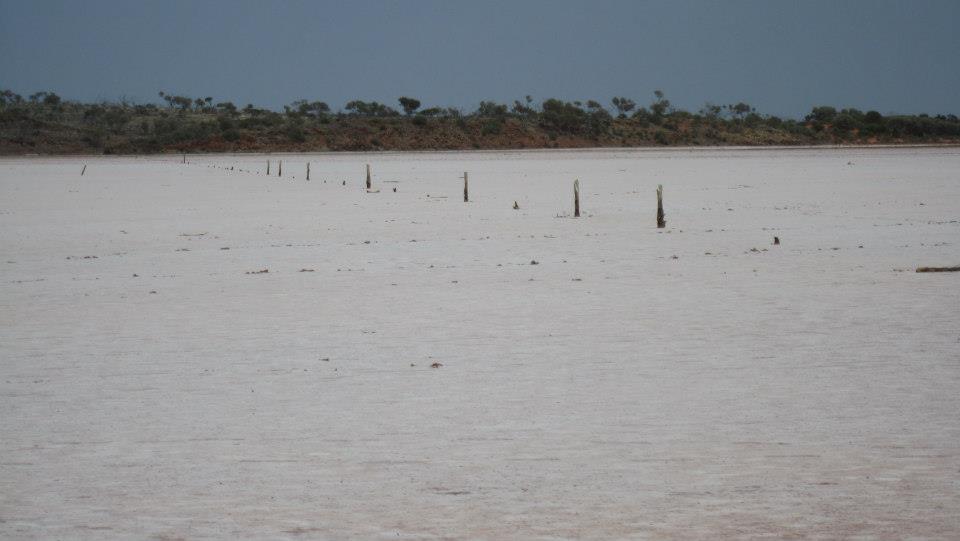
More impressive was what we found two days earlier while visiting the Inside Australia sculptures on Lake Ballard:


Remnants of the No. 1 Rabbit Proof Fence – the real deal!


To clarify:  I’m not an engineering geek.  And this isn’t orgasmic…

But I am a nerd.  And this was pretty exciting.


Saturday, January 12, 2013

Inside Australia

130 kilometres north of Kalgoorlie sits the town of Menzies.  This little town with a population of only 56 people is pretty far into the middle of nowhere.  To give you some perspective, the area the town council overseas is roughly the same size as Pennsylvania.  Pennsylvania!  The whole state!  Surely, there must be other big cities or something in an area that big, right?  Wrong.  The total population of Menzies including its rural areas is 231.  231!  That’s like half of one apartment building in Pittsburgh.

Needless to say, driving up to Menzies is about as remote in Australia as I’ve ever been, even more so than the middle-of-nowhere yet popular Alice Springs and Uluru in Northern Territory.  Because of the heat in the desert we set out early to avoid the car overheating (or us overheating).


So, why the heck would Oscar and I drive up to this spot in the middle of nowhere?  The answer could be found roughly 55 kilometres west of Menzies…


Down an old dirt road…


That led us to Lake Ballard – a massive salt flat about 70 kilometres long which only fills up with water once in a blue moon after an intensively heavy rain.  Lake Ballard is one of a group of massive salt lakes – stepping out onto one you can really taste the salt.


Here was our destination, and the attraction that I was most excited about seeing while in Western Australia:  Inside Australia!


Inside Australia is a collection of 51 sculptures spread across 10 square kilometres of Lake Ballard, making it the world’s largest outdoor art gallery.  The sculptures were commissioned and installed in 2003 to mark the 50th anniversary of the Perth International Arts Festival.  They are featured on several tourism websites and commercials, and of course, I just had to go check them out.


The sculptures are based on 3D scans taken of the townspeople in Menzies, though shrunk down a bit in several dimensions.  To walk across the entire 10 square kilometres viewing all of the statues would have taken all day, but we saw roughly 15 – 20 before heading back to Kalgoorlie.  We were the only people at the sculptures that day, and it was a bit eerie to be so far from civilization without reception on my mobile phone (and in Oscar’s very old car), especially in the heat, but we were prepared with plenty of water, snacks, and very sexy fly nets to cover our faces.


We chatted with the locals…


And even made some new friends…


But we kept it strictly platonic.  These townspeople let it all hang out, and with that kind of view, we decided it was best not to get involved.  Can you imagine undressing someone and finding this?


Dear lord!  Who lives in this town and why does their thingy look like that???

On that note, we decided to head back.  Actually, it wasn’t the weird statue penises.  It was the heat.  The high temperature that day was 39 degrees Celsius, and you could see it in the air.


Overall, our trek out to Lake Ballard was well worth the drive – a real outback adventure with some (what should be) big city art thrown in for good measure.  If you’re ever driving north from Kalgoorlie, turn off the main drag and check out the sculptures before the next big rain fills up the lake and dooms them.

Oh wait – you probably won’t be driving north of Kalgoorlie anytime soon, will you?  Or anywhere near Kalgoorlie for that matter, right?

Well, consider that one checked off the list by me on your behalf.