Tuesday, March 20, 2012

Tasmania's National Parks

Despite its small land area, Tasmania is home to 19 national parks.  We had the privilege of visiting 4 very different ones on our 10 day tour.  In no particular order:

Franklin-Gordon Wild Rivers National Park

Named after the Franklin and Gordon Rivers which run through the park, the vast Franklin-Gordon Wild Rivers National Park is Tasmania’s second largest by land area.  Not the most accessible, our visit to the park consisted of two short hikes off of the Lyell Highway which straddles the park’s northern boundary.  First stop, Nelson Falls:


Followed by Donaghys Hill.  From atop the hill, you get a fantastic view of Frenchmans Cap – one of the most recognizable features of the national park.


Both Nelson Falls and Donaghys Hill were on the list of Tasmania’s 60 Great Short Walks which is compiled by the Tasmania Parks & Wildlife Service.  Looking at the brochure after the trip, I was surprised to find that we actually did 10 of the 60 Great Short Walks.  Not a bad effort for a 10 day trip.

Freycinet National Park

I had never heard of the name Freycinet National Park before coming to Tasmania, but one of its main natural features had been near the top of my list of things to do in Australia for quite some time.  I’m referring to the beautiful and famous Wineglass Bay:


Along with the Bay of Fires just a few hours to the north, Wineglass Bay is consistently named one of the most beautiful beaches in the world by beach experts.  I don’t know what qualifies you as a beach expert, but I suppose if you get published in a big magazine or two then you’re somewhat legit.  Looking at the shape of the bay in the above photo, I just assumed that it was named Wineglass Bay solely because of its shape.  But I was wrong.  After the trip, my friend Jessica mentioned it was because of whaling.  Further research found that she was indeed spot on.  Extensive whaling had occurred in the area in the 1800’s.  Whalers would drag their catches into the bay and do whatever it is that whalers do to whales.  On a busy day, the waters of the bay were dyed red with whale blood.  That combined with the shape, looked like a glass of red wine.

Disgusting.

Fortunately, there hasn’t been whaling here in a long, long time and the beach has returned to its uber-gorgeous state:


The water was frigid.  Here’s me bracing as the cold waters came over my feet and splashed up on me:


Despite its beauty, Wineglass Bay is not the only thing that draws people in.  The park sits on the Freycinet Peninsula which separates the Great Oyster Bay from the Tasman Sea and Pacific Ocean.  A short track over the flat isthmus across the peninsula led us by some very different scenery: a lagoon.


We ended up at Hazards Beach on Great Oyster Bay.  The water was so clear.  Had I brought my bathing suit, I would have jumped in despite the frigid temperatures.


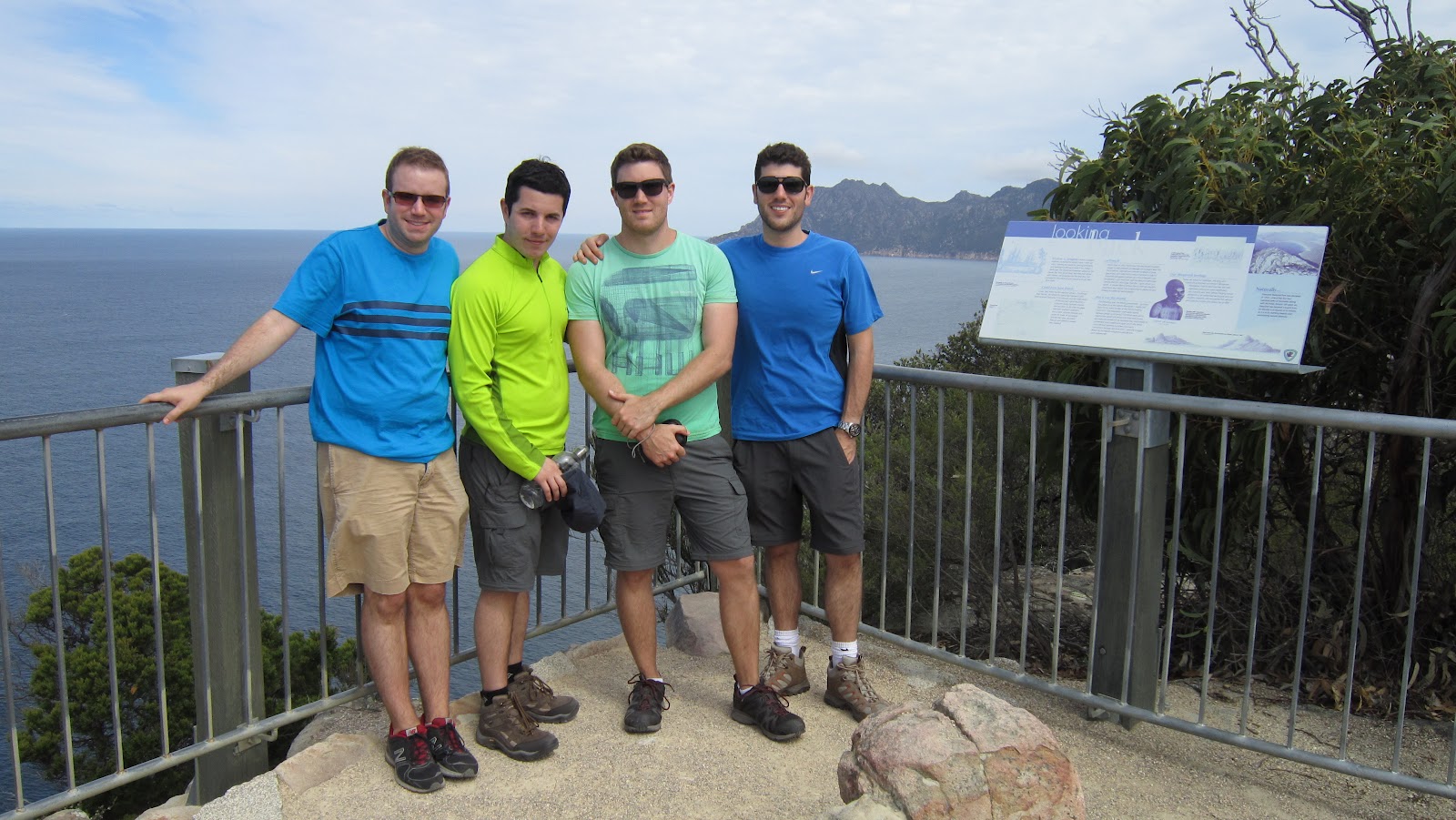
Finally, we drove around the other side of the park to Cape Tourville, site of a lighthouse, views of Wineglass Bay, and a great photo opportunity over the Tasman Sea:

Mole Creek Karst National Park

One of Tassie’s smaller national parks, Mole Creek Karst has an extensive collection of caves.  We toured two of the more famous caves that are open to the public.  King Solomons Cave is named as such for no apparent reason other than to bring in tourists, but it had some impressive stalactite and stalagmite action going on:


King Solomons Cave is a dry cave, while our second cave was a wet one.  The Marakoopa Cave has a river running through it on the ground and a small sampling of glowworms on the ceiling.  One of the main attractions of the extensive cave is the Great Cathedral, named so because of its acoustics.  Additionally, the rock formation in the Great Cathedral looks a bit like a church organ.


Cradle Mountain-Lake Saint Clair National Park

One of the must-do things in Tasmania for most tourists is Cradle Mountain.  We started with the roughly 2-hour Dove Lake Circuit when we arrived one evening.  The views of Dove Lake with Cradle Mountain in the background were stunning:


But even better was our hike the next day.  What started out on a very flat boardwalk track…


… but it very quickly changed scenery a time or two.  There was lush plant life and rivers around Crater Falls:


I missed a separate picture of Michael in the last blog, so I thought I’d make up for it here.  Up a bit further was Crater Lake, which isn't actually in a crater but that’s totally ok because it was pretty.


Up further we reached Marion’s Lookout.  I don’t know who the hell Marion is, but she sure found a place with a nice view.  Down below was Dove Lake (right) and Lake Lilla (left):


In the other direction was Cradle Mountain itself:


I just had to get a panoramic video too (because I’m a nerd… and because I have a really big memory stick on my camera…)  I zoomed in on a little lake just sitting up on the mountain side.  There were heaps of lakes at all different elevations around the park.  Maybe I don’t get out much, but I had never seen anything like it before.

'

Tasmania’s national parks definitely did not disappoint.  Now that we’ve been to four of them, there’s only one thing to say:

Four down.  Fifteen to go.  Tasmania 2013 anybody?


Sunday, March 18, 2012

#87: Port Arthur Historic Site!

Australia has a rich convict history, and nowhere else in Australia is this better exhibited than at the Port Arthur Historic Site in Tasmania.  Port Arthur is nowadays more synonymous with the 1996 massacre which occurred there, when a deranged man randomly opened fire on employees and tourists, killing 35 and wounding many more.  This led to Australia’s strict gun control laws.  All guide books advise to not ask about the massacre as many of the employees working at Port Arthur in 1996 remain there today and many of them lost loved ones and friends.  All the better, because it really gives a chance to focus on the real Port Arthur – the one with convict history.

First opened in 1833, the penal colony at Port Arthur was the destination for the worst of the worst – secondary offenders who were first sentenced to transport to Australia, and upon their arrival, committed more crimes.  It was basically a harder prison for people who were already in prison somewhere else.  This was not a place you wanted to be sent.

We began our Port Arthur experience with a nighttime ghost tour.


The tour was actually quite spooky, especially the once or twice when our guide made sudden movements.


We had planned to wake up the next morning and head up the coast, but it became apparent that all of us wanted to go back to get more of the history and see the site in the daytime.  And so we did.  A small museum in the visitor centre took us through a voyage from England to Australia, and then life at the penal colony on arrival.  The ship’s menu alone was enough to put me off of crime for life:


I seriously would have starved.  Vince was acting up, so I decided to shackle his legs.


You’ve been a naughty, naughty convict, Vince.

The church we had been through the previous evening was less creepy in daylight:


Notice that no roof exists on the church.  Abandoned as a prison in 1877, the property was left to decay.  Whatever wasn’t bulldozed or burned up in bushfires, slowly eroded over time as the locals tried to push aside the area’s convict history.  It wasn’t until the 1970’s that there was enough interest in tourism that the government provided funding to restore the area.  Some of the buildings have only outside walls remaining:


But one of the prison buildings has been beautifully restored to give a true depiction of life in hell.  Here is one of the cells from the separate prison building:


A hammock!  No way!  But there isn’t any indoor plumbing in the cell so the hammock doubling as a toilet seems less exciting now.  The separate prison building has its own church so that the worst convicts didn’t have to mix with employees and their families on Sunday mornings.  I got up there and preached a beautiful sermon about the evils of right-wing evangelicals and the joys of Mexican cuisine.  Sadly, all of the convicts were gone so I couldn’t really spread the word, but at least Vince heard my sermon and applauded mightily at the end.  As I deserved.


Our tour ticket also included a short boat ride on the waters surrounding the prison, with the narrator pointing out the sites of the boys’ prison and cemetery that sit across the harbour.


We left Port Arthur that afternoon, but we had another dose of Tassie’s convict history several days later.  Upon our arrival in Strahan, on Tasmania’s west coast, we were advised to check out The Ship That Never Was, Australia’s longest running play.  The play, which they’ve turned into a comedy, got off to a very rocky, corny start.  But after about 20 minutes, we were all pulled in.  The play tells the story of a group of 10 convicts who stole a ship that was built at a convict settlement on Sarah Island, not too far from Strahan.  They successfully sailed across the Pacific and made landfall on the coast of Chile.  The various convicts involved ended up parting ways, with a few of them being captured and returning to Australia.  At their trial, they argued that because the ship was never formally entered into service after its manufacture, the convicts were guilty only of the much lesser offence of simply stealing a bunch of wood.  And they won.  Clever lads.

The play is fairly low budget in that there are only two actors, plus one aspiring actor child from a local school.  The rest of the parts are filled in by members of the audience, which is where it gets really funny.  As I mentioned in a previous post, everyone is Tasmania is old.  Except for one or two other people, the four of us were probably the youngest people in the audience by a good 30 years.  So, the actors on stage were sure to pick on us.  And they did.  Mainly on Vince who played one of the biggest parts:


Repeatedly…


But Cade, Michael, and I weren’t left alone either.  Michael had a bit part which I unfortunately don’t have any photos of, but I played the ship’s captain who was forced to abandon ship and swim to shore when the floating pile of wood ran aground off Chile:


And Cade – he played a parrot:


Hehe!


Friday, March 16, 2012

MONA Gets Her Own Post

There’s so much that was fantastic about Hobart – the Salamanca Markets, Mt Wellington, Parliament – but there’s one thing that really stood out.  Her name:  MONA.

MONA is the Museum of Old and New Art.  The museum sits on the premises of a winery and also includes a brewery, restaurant, and super swanky hotel.  If that wasn't enough, we stumbled upon another set of markets when we arrived:


They weren’t nearly as big as the Salamanca Markets, but cute nonetheless.  But the best part of it all is the museum itself.  Despite being on a prime waterfront location, the museum is built into a hill so most of it is underground – with the bedrock exposed as some of the walls on the inside.  Opening only last year, the Museum of Old and New Art is the largest privately funded museum in Australia.  Everywhere we went, people would ask us:  “Are you going to the MONA?” or “Have you been to MONA yet?” or “Did you all come to Tasmania to see the MONA?” Apparently people come to Tasmania JUST to see the MONA.  It’s a massive tourist draw.  But why?

All of the artwork inside is from the private collection of the uber-rich David Walsh, a professional gambler from Tasmania.

One dude opened a museum with all his art.  Insane.

What’s even more insane was what was inside.

Penises.  Vaginas.  Lots of art containing penises and vaginas.  And poop.  And ancient Egyptian relics.  And paintings.

Let me explain.

As the name suggests, the museum has both old and new art.  An example of old art is this larnax, or chest-shaped coffin, from Crete.  It dates back to the Late Minoan Period around 1300 BCE.


An example of new art was this uber-contemporary painting which caught my eye:


But then all the art got weird.  Really weird.  And the penises and vaginas came out.


Wow.  And they put this shocking painting right next to this:


An ancient Egyptian sarcophagus.  Right next to that painting of the man with the lady parts.  It somehow seems sacrilegious.  But it somehow seems super cool.  You may expect to find a place like this in Berlin, Amsterdam, or San Francisco.  Even Sydney or Melbourne would have a much better chance of having something like this than little Hobart.  But Hobart has it – adding to the city’s charm, diversity, and outright awesomeness.  Insane!  And you know what else is insane?  The “B” word.  And I’m not even going to spell it out.


Ok.  Wow.  After that, I think we need to bring it back down a level.  How about kisses on paper?


How sweet!  Kisses on paper!  Simple yet cute.  One of the super cool things about the MONA is that there are no plaques with the painters’ names or descriptions on the walls next to the artwork.  When you enter, the friendly staff hand you a weird version of an iPod Touch.  Linked into the museum’s wifi, the iPod uses your location within the museum to pull up all of the art around you.  No more crowding around trying to read a tiny little narrative over the heads of fourteen art snobs.  The little handheld device included audio and everything!  So, let’s look up these kisses on paper and see what it says:


Anal Kisses!  Anal Kisses!  Just when I thought it couldn’t get any weirder.  Those prints were made by assholes.  Literally.

“Hey Cade… Vince… Michael:  Do you smell that?  What is that?  It’s coming from the next room.”


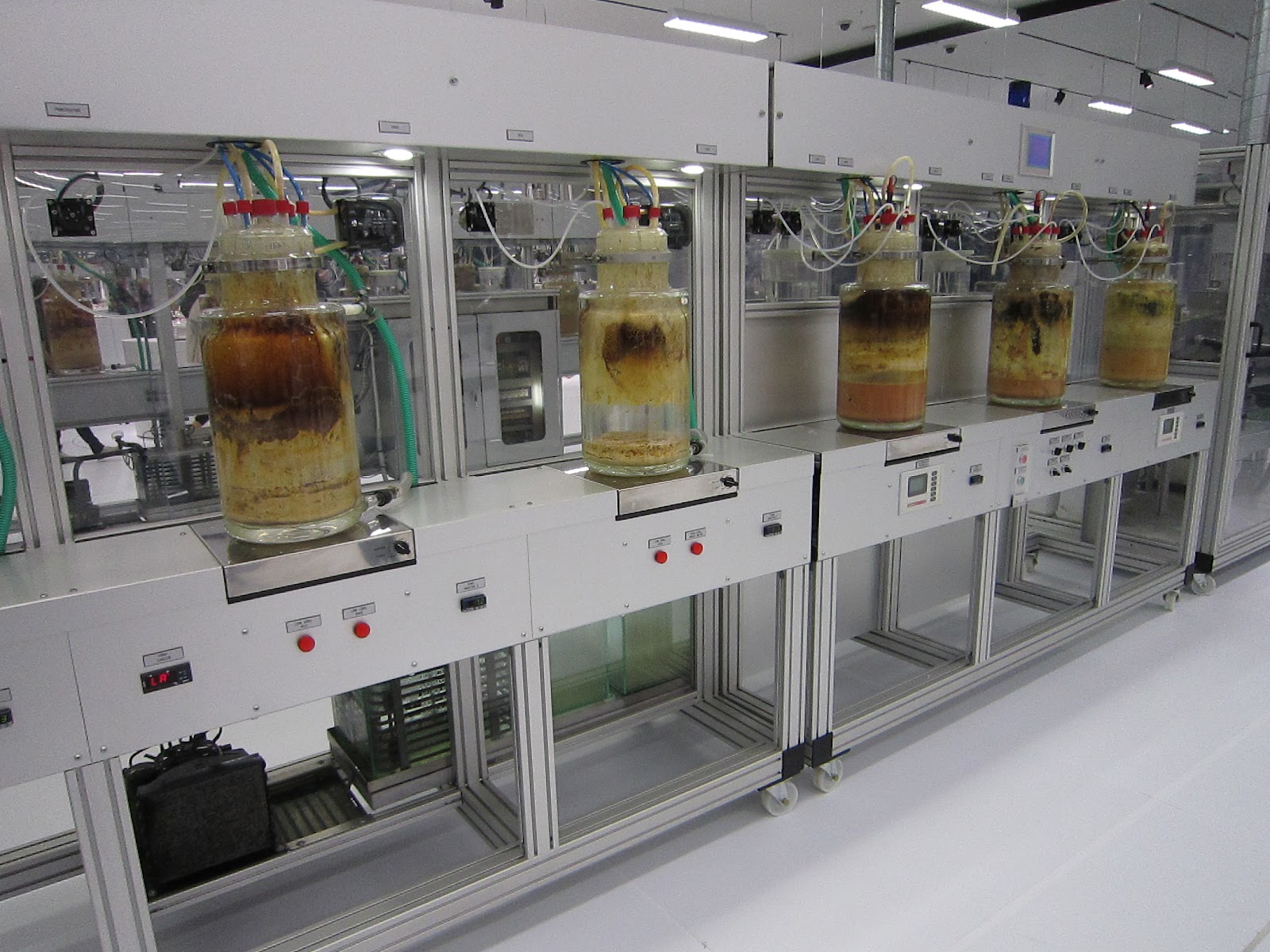
Holy shit it’s a poop machine.  The MONA has a poop machine.  Actually, the MONA had two poop machines when we were there, but only one was permanent.  This machine simulates conditions in the stomach, intestines, and other parts of the digestive tract that I can’t name because I’m not a doctor.  It gets fed normal human food, which then passes through each chamber for processing.  And then, the machine poops.  On schedule.  Just like old people who take Metamucil.


And there it is, people.  And yes:  it really did smell like shit.

So, the MONA was absolutely insane and a must see if visiting Tasmania.  It's huge and we spent several hours there just looking at everything.  And I would agree that visiting the MONA is probably reason enough to fly down to Hobart, but you might as well spend a few days and see all of the other great stuff too!  I’ll leave you all with what I think was probably my favourite piece from the museum:


A series of x-rayed rats re-enacting the Stations of the Cross.

AMAZING.


Sunday, March 11, 2012

Planet Hobart

Hobart!  Tasmania’s capital and largest city was both the first and last stop on our tour of the island.  Hobart was a refreshing surprise.  With a metropolitan population of only around 215,000, Hobart is tiny in scale compared to Sydney, Melbourne, Brisbane, Perth, or even Adelaide.  Hobartians – the extraterrestrial sounding name for the residents of this fine city – don’t seem to get that Hobart is tiny.  Hobart has everything that a big city has – and more.  Firstly:  natural beauty abounds.  The city’s backdrop is the impressive Mt Wellington.  The top is accessible by road, and the view is stunning:


A cloud of smoke from a bushfire obscured our view a bit, but the colours it brought in were great:


Down on the ground, Hobart’s harbour is cute and quaint, and the old British buildings give the whole city an old European charm.


Notice Mt Wellington obscured by clouds in the background:


Our Parliament tour – which we were the only people on – was fantastic.  The old historic building retained its 19th century feel while incorporating all of the new technological advances that members of Parliament need.


As part of the Commonwealth, Tassie’s little Parliament still does all of the formalities reminiscent of the Queen and olden days.  These old touches – likes the hourglass timers they still use for debate – bring you back in time (or maybe bring you to the Wizard of Oz?)


With the two houses of Parliament having only 25 and 15 members, it’s hard to compare this parliament to any of the other parliaments or state capitols that I’ve toured before.  So small and trusting, we actually got to see legislation on the desk.  How appropriate that it was marriage equality legislation.  Awesome!


Speaker of the House Phill declares:  “Order in the chamber!  And burritos!”


Also English in nature are the beautifully maintained Royal Tasmanian Botanical Gardens, incorporating all sorts of European, native, and other plants.


The Salamanca neighbourhood is jam-packed with historic buildings, but it’s what’s inside that is completely different.  This little café creatively doubles as a laundromat.  No.  We’re not in Sydney.  This is way more unique than anything I’ve seen in Sydney.


Salamanca is also the location of Hobart’s famed Salamanca Markets.


The market has an amazing assortment of food – which will be discussed later on – but all of the other items were just incredible too.  Wooden objects – made from Tasmania’s famed and ultra-durable Huon Pine – dominated the crafts sector.  Little Huon Pine echidna toothpick holders?  ADORABLE!


Never before has wood looked so appetizing!


It wasn’t just wood though.  There was plenty of other kitschy, elegant, tacky, cute, bizarre, and beautiful wares for sale as well.  Like this apron with a strategically placed Tasmania on it…


Wow.

And just like the much larger Sydney, Melbourne, Brisbane, Perth, or Adelaide, little Hobart even has its very own gay club!  Flamingos – an ironic name in a place that’s about as far away from Florida as possible – is Hobart’s only full-time gay establishment.  It was… unlike anything we have in Sydney.  Upstairs was a lounge room with pool tables and a jukebox.  It reminded me of my college dorm.


We had fun anyway.

And downstairs, the Hobartians were schmoozing around the dance floor and stripper pole.  I was starting to really like this place because it was a completely down-to-earth alternative to the bitchy, pretentious gay clubs in Sydney.  But just when I was starting to really appreciate it, the night’s entertainment came out.  What attracted us to the club was a poster we first saw on a lamppost on the street earlier that day:

“A night for the Guys & Gals that'll get hot and steamy!  The MEN of Body Heat return to HOBART for one night only for their BORN TO BE WILD TOUR!  Round up your crew for a night of Hot, Hard, Hunks, as they take to the Flamingos Dance Bar stage!  A night of naughty mayhem not to be missed!”

Sounds hottttttt!!!!!!!!!!

But what we got:  three older busted dudes with bellies dancing to Grease Lightning.

I wish I was kidding.


And the Hobartians went wild – they were enjoying it beyond anything I’ve ever seen.

This is a strange planet.


Tuesday, March 6, 2012

"Next Trip"

There’s really only one way to describe Tasmania:  fantastic.  Simply fantastic.  It doesn’t even need an exclamation mark.  A period (full stop) will suffice.

Or, for added emphasis, maybe fan-fucking-tastic.

As I mentioned in my last post, Tasmania has been the butt of every joke mainland Aussies have made for decades.  Taswegian – a name for a Tasmanian that I thought only my friend Ross used as a joke, but later found in a travel guide to be a real running gag that actually stems from something historical way back in the day – is defined in UrbanDictioanry.com as “A local from Tasmania.  Six fingers, two heads, etc.”  Somewhere in the last decade or two, Tasmania changed.  Or, more likely, everybody else just noticed that the little island state just south of Australia actually is a gem and that all the stereotypes weren’t really credible.  While jokes about the small gene pool and all Tasmanians having two heads persist (even the locals there still joke about the scars on their necks from the removal of their other appendage), there really isn’t anything anybody can say that would be remotely negative about Tasmania.  Seriously.  It’s fantastic.  Why is it so fan-fucking-tastic, you ask?

Everybody is friendly.  EVERYBODY.  I can’t think of one Tasmanian that we encountered that wasn’t the model of politeness.  Everywhere we went, people seemed genuinely curious out where we were from and where we were going in Tasmania.  They threw out helpful hints of places to eat and things to see.  A few of them were a bit kooky, and maybe a few were a bit off, but they were so just so nice that we could hardly notice.  And all the while they smiled.  They smiled big.  Doesn’t that start to hurt after a while?

Not only are they friendly, but they are gay friendly.  The whole island it seemed.  When I booked our first accommodation in Hobart, all they had left were rooms with two single beds.  When Tildy, the lady who ran the Astor Hotel where we stayed, found out that two of my mates were a couple, she was so apologetic about not having a room with a double bed for them when we booked.  Nothing changed after that.  Nobody who we met in our accommodations or hiking or wherever else seemed to think twice at the thought of two dudes – not even the older people.  Gay and lesbian travel websites list pretty much every hotel, B&B, attraction, and whatever else in Tasmania as gay friendly.  We stopped at a little café in the tiny little town of Rosebery, and the two men behind the counter were a bit small-town-redneck looking… until we realized that they were just a really butch couple.  In retrospect, the fact that it was a café AND gallery should’ve given that away immediately.  There was marriage equality legislation on the desks of the members of the House of Assembly when we took our tour of Tasmania’s Parliament, and we even saw a rainbow on day 2.  How gay friendly is that?!?

Aside from being friendly and gay friendly, everything is fucking adorable in Tasmania.  Now, I add the “f” wording for emphasis because plain old adorable doesn’t really cover it.  Every café we went to was cuter than the next.  And even the ones in the city felt like they were in a quaint little town.  And the ones in tiny little podunk towns were actually really nice and served proper food.  We stayed at some ridiculously cute cottages in the middle of nowhere which were just so surprisingly nice and homey, and the native species are endearing as anything.  (If you don’t think that wombats are just the cutest then you have some serious issues.)  How is everything so cute here???

Everything is old in Tasmania.  Well, old for Australia at least.  Hobart is the second oldest city in Australia.  And, being settled years or decades before Victoria, Queensland, South Australia, or Western Australia, most of Australia’s earliest European settlements were in Tasmania.  Unlike Sydney, which has grown up into a real proper city with big glass and concrete skyscrapers, Hobart hasn’t.  Nowhere in Tasmania has, so Hobart and everywhere else around the island retain an old European charm.  Here you’ll find Australia’s oldest pub:


Australia’s oldest brewery:


Australia’s oldest bridge:


And a bunch more of “Australia’s oldest” things.  It’s an Australian history nerd’s playground.  Also, the people are really old in Tasmania.  I’m not sure why, but everywhere we went there were just heaps of old people.  It felt like childhood in Florida all over again.

So what else?  Well, there is just so much to see.  With tons of history and tons of magnificent natural features, you need a month to just drive around and see all that is on your list.  It became very apparent very early in the trip that we just weren’t going to get to see everything we wanted to.  And then, just when we thought we had a good idea of what we were missing, some other random super-friendly Tasmanian would ask us if we were going to see such and such a place and that it is a must-see and we couldn’t possibly miss it.  And all we could say was “next trip.” Because there will have to be another trip.  Another two trips probably. 

On top of there being so much to see, Michael put it best when he said on a nearly daily basis that “Everything has been a highlight so far!”  True.  Nearly everything in Tasmania exceeded expectations.  Whatever Tassie has in quantity is also has in quality.  Where are these Tasmanians hiding all their bad shit?  Nothing disappointed at all, except for my lack of mobile phone service throughout most of the state, but that’s not Tasmania’s fault.  It’s my fault.  I’m with Vodafone.

So, I headed out with Michael, Cade, and Vince:


… In a very strange rental Toyota Rukus.  Has anyone ever seen or heard of one of these before???  I lovingly named her Roxy because she was so boxy…


We reached the southernmost point that any of us had ever been to before in Geeveston, Tasmania, covered over 1,776 kilometers in the car, and took nearly 2,500 photos and videos collectively (in all fairness to the other boys, nearly 1,400 of those were mine… oops…)  And everything – everything – was just super fantastic.

More photos, details, and commentary to follow about every fantastic thing that we saw.


Thursday, February 16, 2012

Travel Bug

Normally, after a vacation, I’m always glad to be home.  Vacations generally aren’t restful for me.  I like to go and do and see as much as I can while I’m in any given place.  I mean, if I wanted to sit on a beach and relax, I could go down the street.  I live in Sydney after all.  So, whenever I land, I arrive home, take a shower, and just lay down on my bed or the couch for a while.  I’m usually so glad to be home so I can just sit still for a while and rest some.

Coming back from China in October, however, was a whole different story.  I was happy to have my own bed, my own shower, and my own toilet, but I really wasn’t all that content.  Yes, I came back and showered and laid down for a while as per usual.  But while I was lying down, I was on my laptop looking up my next trip.

After discovering the joys of traveling on a group tour, I thought “well hell, I should go somewhere new.”  Everywhere new actually.  I do have my list of 103 Things that I want/need to do around the world, but in my head, the list tripled.  In mainland China, I had one thing on my list:  The Great Wall.  But the Terra Cotta Warriors were just as spectacular, the Forbidden City was cool, and the Shanghai Jewish Refugees Museum was an unexpected small treasure.  If I was missing all of these things on my list, what else am I missing???

Living with Clinton, my new flatmate, hasn’t helped at all.  He loves travel too, and he likes nerdy documentaries.  He turned on Joanna Lumley’s Nile one day and I was immediately sucked in.  I never even thought of going to all of the places she went – from Egypt, through Sudan and Ethiopia, down to Rwanda – but now I want to.   Add a few more things to the list.  And I’m totally sending him the bill for that one.  Or maybe I’ll send it to Joanna Lumley.  By “send”, I mean hand deliver, because I’d love to meet her!

The number of hours I’ve spent on the computer looking at websites for Lonely Planet, G Adventures, Intrepid Travel, Wikitravel, Gecko’s Adventures, and countless others is… staggering.  It has helped me kick my bad habit of looking at Wikipedia and, 4 hours later, realizing I’ve gone through 30 articles and now know a huge amount of useless information about something random like bonobos or Nunavut.  But now I’ve just replaced one vice with another – hours upon hours of looking at different tours and pricing flights and figuring out what vaccinations I would need to go to that unheard of country.

Some of them are easy from Australia – like this quick 10 day Vietnam trip which goes the length of the whole country from top to bottom:


Asia is easy – especially from Australia – but Africa is a much bigger adventure.  Most westerners who do a safari tour in Africa stay south.  From Cape Town, through Namibia, Botswana, and into Zambia seems to be the most popular.  Tanzania is up in the rankings too.  But I found this 3 week jewel in a very different part of Africa – Senegal, Mali, and the Gambia.  The best part is:  it actually incorporates two of my 103 Things – the House of Slaves Museum in Dakar, Senegal, and the Great Mosque of Djenne in Mali:


In searching for that one, I found another nearby tour which hits completely different countries, none of which I ever really thought to go to and definitely aren't represented on my 103 Things:


Voodoo Kingdoms?  Burkina Faso, Ghana, Togo, and Benin?  Bring.  It.  On.

The crown jewel of trips – the apple of my eye – is this one:


18 days aboard the MS Expedition and a day or so in Argentina on either end.  Antarctica, the Falkland Islands, and the South Georgia Islands would be truly incredible.  Now, looking at the price tag, it will be a long while before I get to go.  Unless of course I find me a sugar daddy or win the lottery stat.  In the meantime, a more plausible option is this one:


When my mate Lenora was here in September, we made some plans for the Trans Siberian Railroad in 2013.  Anyone want to join?

In the meantime, I have another trip to hold me over.  It may not be to a far off place like Siberia, Senegal, or Antarctica, but it’s exciting in its own right.  This weekend, I head off with Cade – one of my Perth travel buddies – along with his partner and another mate.  Destination:  Tasmania!  Little Tasmania – the island state – has a reputation for being inbred.  Despite that, I am totally pumped to go.  Actually, I’m probably more excited about seeing Tassie (as the locals call it) than I have been about any other part of Australia.  Why?  Tasmania – once the most backward state and the butt of every joke – is now the most progressive state.  While the inbred jokes remain, every other review of the island is nothing less than stellar.  The last state to decriminalize homosexuality has now taken the lead in gay rights legislation.  With green energy, Tasmania is at 100%.  The food, wine, and arts are supposed to be divine.  And 45% of the island is protected in national parks and other reserves because the scenery is said to be spectacular.  On top of that all, Tasmanians have a reputation of being super friendly – maybe a little off – but super friendly nonetheless.  What are we going to see?  EVERYTHING! … or at least as much as we can squeeze in…

I’m stoked!

As always, blogs and pictures to follow upon our return.  Woohoo!